
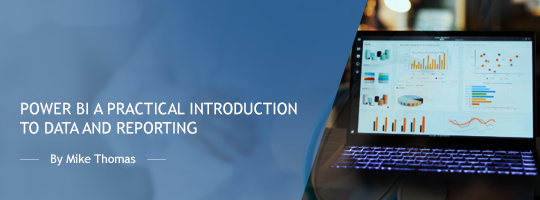
Power BI: A Practical Introduction to Data and Reporting

03/31/2026
Live Webinar
3 day
11 hr
59 min
14 sec

Are you ready to embark on a journey that will revolutionize the way you work with data? Welcome to “Power BI for Beginners – Turn Data into Decisions”

Discover the power of Microsoft’s revolutionary application, Power BI. Designed for beginners, this comprehensive training session will introduce you to the world of data visualization and insights like never before.

Say goodbye to the days of relying on IT departments for subpar reports. With Power BI, you take the reins, becoming a self-service reporting pro.

Objectives

Master the art of creating compelling reports using Power BI Desktop (Windows only). Learn how to design interactive, visually striking reports and effortlessly share your insights.

Why You Should Attend

The true value of your data is in the insights it can provide. Power BI empowers you to unlock the full potential of your data, helping you make informed, data-driven decisions that drive your business forward. If you’re eager to elevate your reporting capabilities and harness the full potential of Power BI, this training session is an absolute must-attend event.

Topics Covered

  • Connect data sources (Excel, databases, text files, etc.) to Power BI
  • Elevate your reports with engaging visual elements
  • Apply professional formatting, including colours, fonts, and styles, to your reports
  • Streamline report updates when the underlying dataset changes
  • Create interactive filters to enhance report interactivity
  • Automate data preparation
  • Easily share your reports with colleagues

Who should attend

This training caters to a diverse audience, including business analysts, data professionals, and anyone with an interest in data analysis. It provides the foundational knowledge and skills needed to unlock the full potential of Power BI.


Please note that course covers Power BI Desktop which is exclusively available for Windows and is not compatible with Mac or mobile devices.

Join us on this transformative journey, and let’s demystify the world of data together! Your data has stories to tell – it’s time to give them a voice with Power BI.

Date: 03/31/2026

Time: 12:00 pm - 1:30 pm (EST)

Reg. deadline: 03/30/2026

Venue: Live Webinar

Enrollment option

Speaker

Mike Thomas
Mike Thomas have worked in the IT training business since 1989 and although he has a subject matter expert in a range of technologies, particularly Microsoft Office, my passion is for all-things-Excel-related with Power BI coming a close second. In a career spanning 30+ years, he has delivered training to thousands of people as well…

Related Events

Excel: Practical Pivot Tables for Fast and Flexible Reporting
Compliance Webinars
Live Webinar

Excel: Practical Pivot Tables for Fast and Flexible Reporting

Pivot Tables are one of Excel’s most powerful and misunderstood tools but once you know how to use them, they can transform how you analyse and report on data. In just a few clicks, you can summarise thousands of rows into meaningful, dynamic reports - no formulas required. This session will show you how to quickly create and customise Pivot Tables to reveal trends, answer questions, and support better decision-making. You’ll also discover how to turn your Pivot Table into a visual dashboard using built-in charting tools, slicers, and layout options. If you've ever looked at a Pivot Table and thought, “I should really learn that”, this is your moment. Why you should attend Manually building summaries and reports from Excel data is time-consuming and error-prone. Pivot Tables eliminate the guesswork, automate the process, and give you instant insights. This session is perfect if you want to save time, reduce complexity, and finally get confident with one of Excel’s most powerful (but underused) features. Topics covered How to structure your source data for best results Creating Pivot Tables in just a few clicks Summarising data with totals, counts, and percentages Formatting your Pivot Table for clarity and impact Sorting and filtering with built-in tools and slicers Visualising data using Pivot Charts Understanding and using (or avoiding) GETPIVOTDATA Who should attend This session is for anyone who wants to level up their Excel skills and gain confidence with Pivot Tables. It’s ideal for professionals in admin, finance, HR, operations, or anyone who builds regular reports. You should be comfortable with basic Excel tasks like entering data, using copy/paste, and applying simple formatting. The training is delivered using Excel for Windows (Microsoft 365), but most techniques also apply to earlier versions and Excel for Mac.

Care of the LGBTQI + Patient and their Families:   Policies, Procedures, & Practices
Compliance Webinars
Live Webinar

Care of the LGBTQI + Patient and their Families: Policies, Procedures, & Practices

Whether your employer is a clinic, a hospital, home health, or long term care; whether you are an MD, RN, an occupational therapist, a receptionist, or in the C-Suite, approximately 5% - 10% of your patients may be gay, lesbian, or bisexual. Additional patients may be transgender, intersex, or questioning their gender identity or sexual orientation. The healthcare needs of GLBT patients may appear to be the same as other patients’, but institutionalized heterosexism in healthcare is a real barrier to quality care. Healthcare providers acknowledge they are serving more GLBT patients, and that they want to provide quality GLBT care, but aren’t sure how to best create and implement the policies, procedures, and practices to ensure best patient outcomes. GLBT patients face a multitude of barriers to equitable care such as: refusals of care, delayed or substandard care, mistreatment, inequitable policies and practices, end-of-life issues, and limits on visitation. The challenges begin from the beginning of the health professionals’ relationship with their GLBT patient—starting from asking them to identify if they are male or female, married or single, on their intake form. Objectives To list relevant laws, regulations and standards required for health equity and patient-centered care of GLBT patients To identify key policy, procedure and practice issues related to GLBT patients and their families to incorporate into already existing policies, procedures and practices To discuss opportunities to collect GLBT – relevant data and information during the healthcare encounter To identify or revise strategic community outreach efforts to the GLBT population To name a variety of resources Who should Attend? HR Management Nurses Other Health Professionals  

Effective Decision Making: A Critical Skill for Managers
Compliance Webinars
Live Webinar

Effective Decision Making: A Critical Skill for Managers

Everyone makes decisions, but of course some decisions are more important and complex than others. Whether it is a decision about what to wear to work to deciding on a merger, the decision making process is generally the same. Most decision making by management is convoluted with much fuzziness and backtracking. Research suggests that managers put little thought into the decision making process such as—analysis of the risk, what values are poignant, the alternatives evaluated, quantitative and qualitative data, identifying the stakeholders, bias, and the impact of the decision on the system, to name a few. Decision making is the basic foundation of the process of management. Yet most management training and development tactics ignore this essential skill. Learning Objectives To examine the “act of choice” To analyze roadblocks to effective decision making To discuss 10 decision making/problem solving tools To list the various models of decision making Analyze how managers make decisions Who should Attend? HR Management Any Employee

Engaging Your Team in Critical Thinking
Compliance Webinars
Live Webinar

Engaging Your Team in Critical Thinking

It is our nature to think—we all do it, obviously. However, a good share of our thinking is biased, distorted, or incomplete. Critical thinking is an essential skill for both managers and employees. Few of us are effective critical thinkers though research suggests that leaders believe they think quite well. Critical thinking ensures we pose the right questions, view others’ viewpoints with merit, and challenge assumptions in strategic thinking, decision making and problem solving. Non-critical thinkers shoot down ideas before they are understood, or take action based on faulty assumptions resulting in a business disaster. Teams, as well as individuals, must learn to think critically which requires a work atmosphere that is conducive to challenging others’ perspectives. Critical thinking enables teams to develop positive insights and ideas that lead to effective action. It focuses on reframing and rethinking issues so that the right problems are addressed, and requires challenging conventional wisdom. Using the process of critical thinking leads to reasoned conclusions, better decisions, fewer mistakes, and improves collaboration among team members. Learning Objectives Define critical thinking List characteristics of critical thinkers Examine the critical thinking process Explore the elements of reasoning Discuss critical thinking techniques Identify organizational, team, and individual critical thinking barriers Who should Attend? HR Management Any Employee